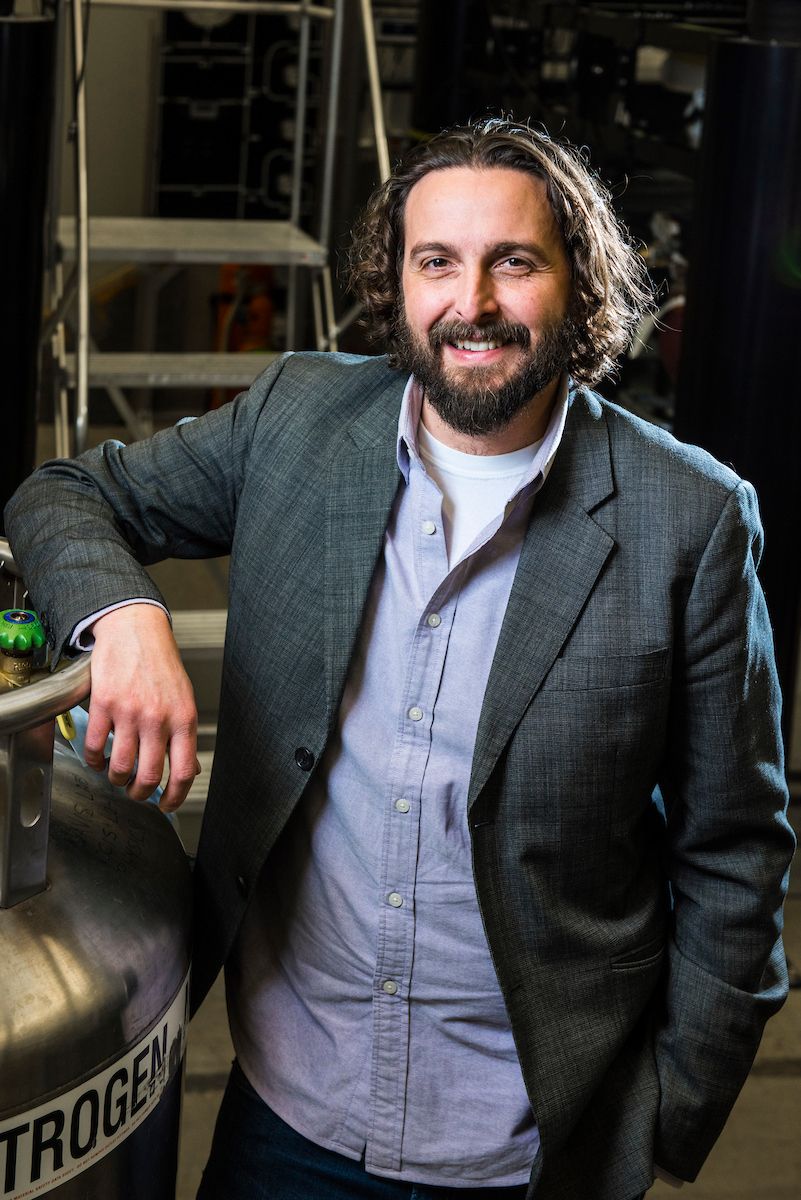
Prof. John Davis (Univ. Alberta) Colloquium

US/Eastern
Description

https://sites.ualberta.ca/~jdavis/

Davis Lab research focuses on large scale quantum objects, in particular nanomechanical objects at low temperatures and superfluids in restricted geometries.  This work combines precision nanofabrication, cryogenics, optomechanics, and quantum measurement protocols.  We are also interested in putting these devices to good use, especially in future quantum technologies

  • Monday 10 November
    • 1
      Pickup at Cumberland House and travel to campus
      Speaker: Prof. Adrian Del Maestro (University of Tennessee, Knoxville)
    • 2
      Meeting with UTK Physics & Astronomy Faculty 403 (Nielsen )

      403

      Nielsen

      Speaker: Prof. Adrian Del Maestro (University of Tennessee, Knoxville)
    • 3
      Meeting with UTK Physics & Astronomy Faculty 308 S. College

      308 S. College

      Speaker: Michael Guidry
    • 4
      Meeting with UTK Physics & Astronomy Faculty 604 (Nielsen)

      604

      Nielsen

      Email and Work time

    • 5
      Meeting with UTK Physics & Astronomy Faculty 202 (SC)

      202

      SC

      SC202

      Dien Nguyen

    • 6
      Meeting with UTK Physics & Astronomy Faculty

      Rpbert Grzywacz

    • 7
      Lunch
      Speaker: Prof. Adrian Del Maestro (University of Tennessee, Knoxville)
    • 8
      Meeting with UTK Physics & Astronomy Faculty 203 (South College)

      203

      South College

      Speaker: Wonhee Ko (University of Tennessee, Knoxville)
    • 9
      Meeting with UTK Physics & Astronomy Faculty 104 (South Colleg)

      104

      South Colleg

      Speaker: Lucas Platter
    • 10
      Meeting with UTK Physics & Astronomy Faculty 604 (Nielsen)

      604

      Nielsen

      Speaker: Dr Kostya Nasyedkin (ORNL)
    • 11
      Pre-Colloquium Reception 3rd Floor Atrium (SERF)

      3rd Floor Atrium

      SERF

    • 12
      Colloquium: Sensing Gravitational Waves and Dark Matter with Superfluid Helium 307 (SERF)

      307

      SERF

      Observations spanning multiple astronomical scales point to the existence of an unknown form of matter, dubbed “dark matter”, that constitutes over 85% of the mass of most galaxies. Recent theoretical insights into the possible nature of dark matter and how it interacts with normal matter have inspired a wide range of experimental efforts aimed at directly detecting dark matter. As part of this effort, we are developing a small-scale experiment to search for multiple well-motivated “ultralight” dark matter candidates, placing stronger bounds than are currently possible with high-cost and/or large-scale efforts. The core enabling technology relies on microwave cavity readout of mechanical motion in superfluid helium. I will tell you about the experiments that have led up to where we are now, and our current efforts with regards to this table-top dark matter search.

      Speaker: Prof. John Davis (Univ. Alberta)
    • 17:00
      Break and Return to Hotel
    • 18:00
      Dinner
  • Tuesday 11 November
    • 13
      Pickup at Hotel and Travel to IAMM
      Speaker: Prof. Adrian Del Maestro (University of Tennessee, Knoxville)
    • 14
      Research Discussion
    • 15
      Research Discussion -Alan Tennant IAMM 309
      Speaker: Alan Tennant
    • 16
      Research Discussion 321 (IAMM)

      321

      IAMM

      Speaker: Prof. Adrian Del Maestro (University of Tennessee, Knoxville)
    • 17
      Research Discussion 321 (IAMM)

      321

      IAMM

      Speaker: Prof. Adrian Del Maestro (University of Tennessee, Knoxville)
    • 18
      Research Discussion 300 (IAMM)

      300

      IAMM

      Speaker: Tony Mezzacappa
    • 11:30
      Lunch
    • 19
      Zero Point Cryogenics 310 (IAMM)

      310

      IAMM

      In general, quantum technologies must be operated in the sub 1 K regime, a demanding area of cryogenics. In fact, the technologies to reach below 1 K with continuous operation are few and far between, and therefore the dilution refrigerator, capable of continuous operation in the mK regime is often the preferred choice. I will begin by reviewing the principles of operation of a dilution refrigerator, and tell you about some of the advances in dilution refrigerator technology that we have made at Zero Point Cryogenics. Following this, I will describe our new, patent-pending technology that we call the phase separation refrigerator. It allows continuous operation below 500 mK, with very fast start-up and minimal 3He usage. We believe this will find significant applications in the future of quantum technologies.

      Speaker: Prof. John Davis (Univ. Alberta)
    • 20
      Research Discussion 257 (IAMM)

      257

      IAMM

      Speaker: Yang Zhang
    • 21
      Research Discussion G007 (IAMM)

      G007

      IAMM

      ULT-STM Lab tour

      Speaker: Wonhee Ko (University of Tennessee, Knoxville)
    • 22
      Depart for Airport