Choose timezone
Your profile timezone:
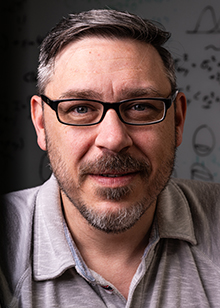
Prof. Hazzard theoretically studies the behavior of ultracold atomic systems. He is interested in "emergent" properties of many-body systems, and spends most of his time thinking about this phenomenon in ultracold gases. The vision is that fundamental advances in controlling, measuring, and understanding these many-body quantum systems will impact our knowledge of other fields through "quantum simulation", broadly construed, and enable applications in quantum metrology, precision measurement, and quantum computation.
SC104
Robert Grzywacz
Particle exchange statistics is a fundamental characteristic of quantum matter, conventionally thought to be constrained to either fermionic or bosonic. Each type gives distinct phenomena: fermions and the consequent exclusion principle lead to the structure of the periodic table and properties of metals, while bosons and their bunching give lasers and superfluidity.
I will discuss recent research in our group that has shown other exchange statistics are possible (beyond already-known anyons, which are restricted to two dimensions) and naturally emerge as excitations in spin models. These “paraparticles” admit non-interacting theories, unlike anyons, and I will describe our vision of using this to form the foundation of new analytic and numerical methods to provide a window into correlated matter.experiments that have led up to where we are now, and our current efforts with regards to this table-top dark matter search.
Adrian Del Maestro